Prepare the compound
We start with the specified rubber grade and target properties, such as hardness or flexibility.
Explore Rubber Compound
Production · Faridabad, India
In-house rubber curing for moulded and rubber-to-metal components.
During vulcanisation, heat activates the cure system and forms links between polymer chains. The cured rubber’s flexibility and recovery depend on both the formulation and the cure cycle.
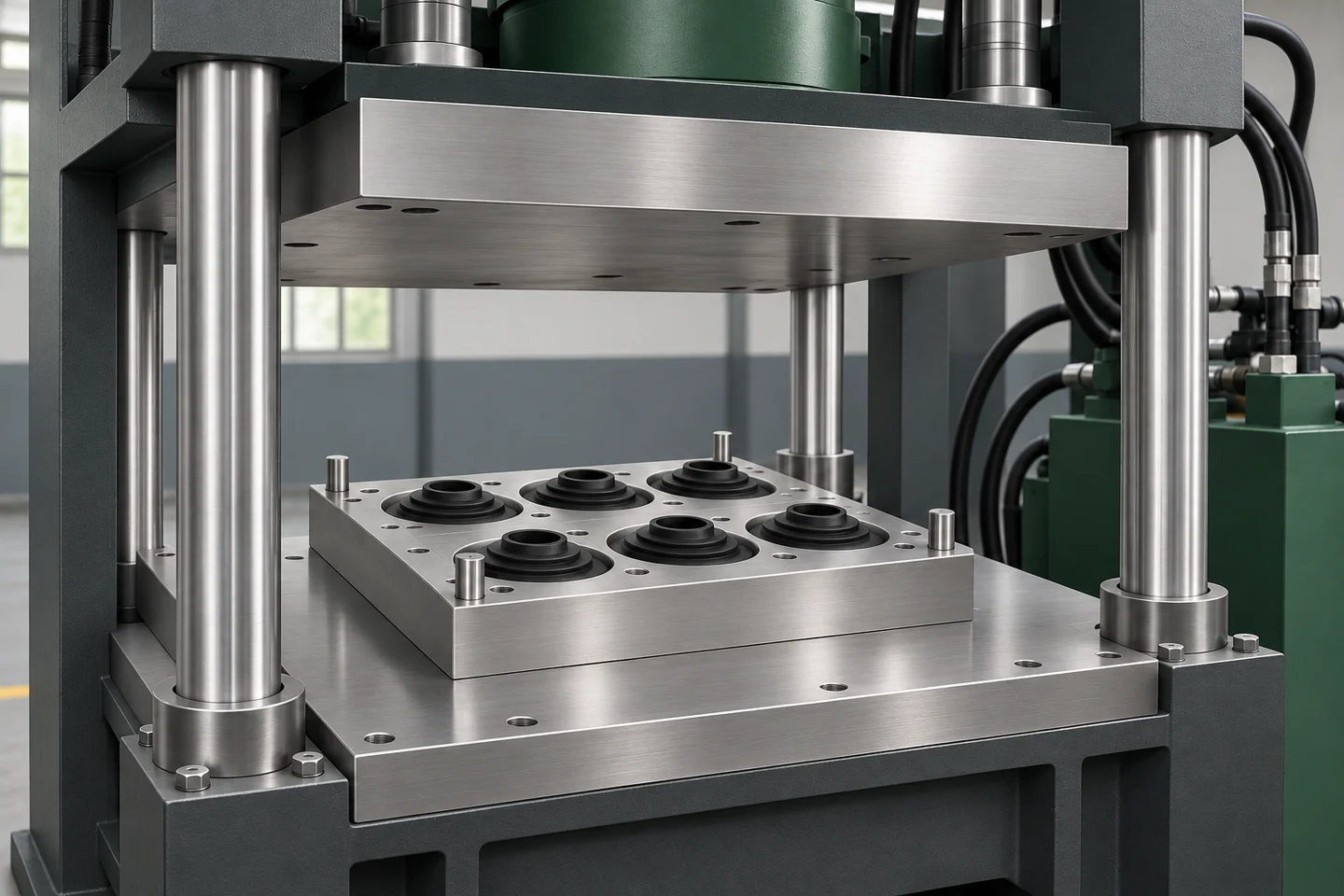
The curing cycle depends on the rubber formulation and the part geometry. We use the drawing and intended application to plan the sample and agree what to check.
Load the mouldThe uncured compound is placed in the open mould. Where specified, a metal insert is located in the tooling.
We start with the specified rubber grade and target properties, such as hardness or flexibility.
Explore Rubber CompoundWe mould and cure the part in-house. For bushes and vibration mounts, we position the specified metal insert in the mould and bond the rubber to it during production.
Review the cured profile, hardness and surface condition. For bonded parts, agree any insert-position or bond requirements and the method used to check them.
Explore Quality ControlShare the drawing revision or reference sample, critical dimensions, rubber grade and target Shore A hardness if specified. Include expected loads, operating temperature and contact with fluids where relevant.
Include the quantity, delivery destination, and any required test standard, inspection criteria or documentation. For rubber-to-metal parts, share the metal insert specification and any bond requirement.
Use the same enquiry form for deliveries within India and overseas.